
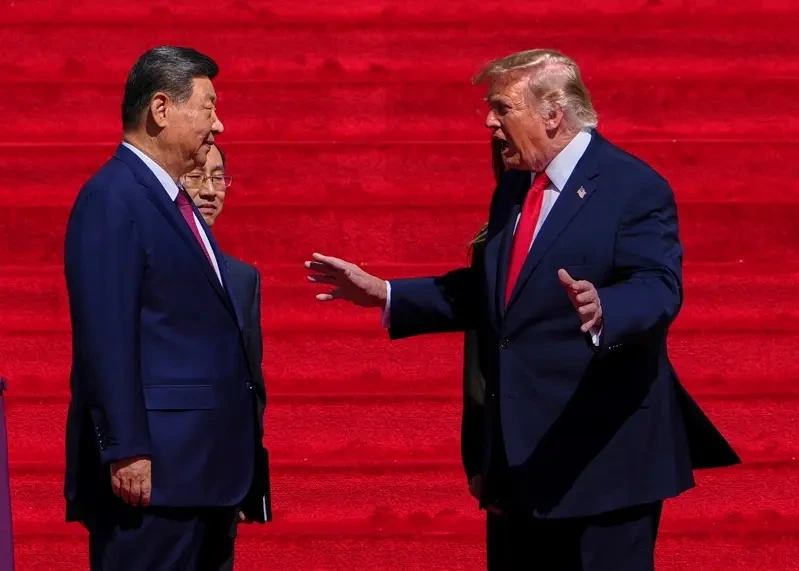
On the 13th, the Brookings Institution, a U.S. think tank, published an article by senior fellow Ryan Hass titled “Repairing America’s signaling on Taiwan.” The piece notes that the Trump administration employs a top-down decision-making style regarding China and cross-strait issues; given Trump’s established pattern of rhetoric, it is highly unlikely that the U.S. will articulate its position on Taiwan with greater precision during the remainder of his term. Future U.S. administrations must learn from Trump’s mistakes and strengthen the credibility of signals regarding policy toward Taiwan.
The article points out that after returning from a visit to Beijing in May, Trump drew attention for accepting several of China’s positions on the Taiwan issue. These included stating he “would not like to see [Taiwan] move toward independence,” questioning the logic of the U.S. military traveling “15,300 kilometers to fight a war,” and describing a pending $14 billion arms sale to Taiwan as “very good bargaining chips” for negotiations with Chinese President Xi Jinping.
The Trump administration appeared to realize that the ensuing controversy had overshadowed the achievements of the May visit to Beijing; consequently, the Taiwan issue was deliberately downplayed during Xi Jinping’s visit to Washington in late September. In an interview the day after the state visit, Trump stated, “We didn’t talk about it [Taiwan] much. Things are good right now; everything is proceeding as usual.”
Hass notes that the White House intended to demonstrate a cooperative relationship between Trump and Xi and to keep U.S.-China competition within manageable limits. However, U.S. Ambassador to China Terry Branstad revealed in a Fox News interview that Trump had proposed selling weapons to China—a disclosure that undermined White House efforts to highlight the personal rapport between the two leaders and the positive outcomes of the state visit.
Observers in Washington familiar with China affairs were generally aware that Trump had long used the argument that the U.S. could also sell weapons to China to deflect pressure from Xi regarding arms sales to Taiwan. However, Branstad’s public disclosure of this matter sparked concern among U.S. domestic audiences and allies, raising questions about the depth of Trump’s commitment to supporting Taiwan. Ryan Hass argues that this reflects the high concentration of U.S. decision-making power in Donald Trump, who views the U.S.-China relationship as an extension of his personal rapport with Xi Jinping; consequently, the rhetoric of Trump and his advisors serves as a key indicator of the direction of U.S. policy.
Hass highlights two important lessons. First, arms sales do not equate to deterrence; deterrence depends on military capabilities, intentions, and an adversary’s perceptions. Over the past year, the U.S. shifted significant military assets from East Asia to the Middle East to counter threats from Iran, thereby weakening its military posture in East Asia. Furthermore, Trump’s imprudent rhetoric has deepened doubts in Taiwan regarding U.S. willingness to intervene in its defense.
Second, substantive progress in U.S.-Taiwan relations cannot offset the perception that the U.S. president’s commitments are wavering. Despite continued deepening of military, economic, and people-to-people exchanges, the Academia Sinica’s 2025 “Portrait of the United States” survey indicates a decline in confidence regarding U.S. reliability.
Hass emphasizes that the U.S. must communicate its policy intentions clearly and consistently. This includes opposing any unilateral change to the status quo across the Taiwan Strait, acknowledging that the choices made by Taiwan’s 23 million people will shape its future, and ensuring that Beijing and Taipei can resolve their differences peacefully, free from violence or coercion.
He believes that U.S. rhetoric regarding Taiwan need not be adversarial toward China, nor should it pander to Beijing. Asserting that Taiwan must remain permanently within the U.S. security perimeter not only denies the right of Taiwan’s 23 million people to determine their own future but also places U.S. objectives in direct conflict with China’s intentions, unnecessarily locking the two nations into a contest of wills over who might blink first. It would not serve U.S. interests for Washington to declare opposition to future cross-strait unification—especially given the lack of broad public support for it in Taiwan—as doing so would effectively bring a potential future flashpoint for war into the present.
Likewise, it would be unwise for the U.S. to attempt to appease China on the Taiwan issue in exchange for concessions on U.S. priorities. Beijing has long regarded Taiwan as an “inalienable part” of its territory; if the United States were to treat Taiwan as a bargaining chip, it would not only expose the ambiguity of its stance on the island but could also embolden Beijing to pursue its objectives more aggressively, thereby jeopardizing long-standing U.S. interests in maintaining peace and stability across the Taiwan Strait.
Ryan Hass notes that resolving cross-Strait differences is not the responsibility of the United States; rather, the U.S. should ensure that both sides retain a pathway to a peaceful resolution of their disputes. In his conclusion, he emphasizes that future U.S. leaders facing pressure from China need not rely on the kind of rhetoric used by Trump; instead, they should remind Beijing that Taiwan’s future hinges not on Washington, but on the will of its 23 million people.